

Slots are the busiest corner of most online casinos, and Canadian players who understand how they work get far more entertainment out of the same budget. Two numbers do most of the explaining: the return to player, which tells you the long-run cost, and the volatility, which tells you how bumpy the ride will be.
Neither number promises a win. Together, though, they let you choose games that suit your mood and your wallet instead of picking by theme or flashing lights. This reference walks through both, along with the habits that keep a slot session fun.
Slot Facts at a Glance
Here are the short answers to the questions slot players ask most. Each point is explained in more detail below.
| Question | Short answer |
|---|---|
| Who decides the result of a spin? | A random number generator, before the reels stop |
| What does RTP mean? | The average share of stakes a game pays back over a huge number of spins |
| Does RTP apply to my session? | No, a single session can land far above or below it |
| What is volatility? | How unevenly wins are spread, from many small ones to rare big ones |
| Can I time the stop button? | No, the outcome is already set |
| Are slots cheaper than table games? | Usually not, their edge often runs higher |
How a Slot Decides Each Spin

Every modern slot runs on a random number generator. The Responsible Gambling Council describes it as a chip that makes a thousand mathematical calculations per second, with the outcome fixed the instant a spin starts.
Why the Reels Are Mostly Theatre
The spinning reels, the sounds and the slow final stop are there for entertainment. By the time the first reel moves, the result is already decided. Pressing a stop button only shows you that result sooner. It cannot change it.
This matters because many habits are built on the idea that a player can influence a spin. Rubbing the screen, changing the stake after a loss or stopping the reels at a certain moment all feel meaningful, yet none of them touches the outcome.
Who Checks the Maths
Independent test labs examine the software before games go live. Well-known labs in this field include eCOGRA, GLI, iTech Labs and BMM Testlabs, and their checks look at three things.
- The source code that runs the game.
- The algorithm that produces the random numbers.
- The statistical output over a very large number of results.
Note. Labs review a generator before a game launches and look at it again whenever the game changes in a major way, so the slot you open today should behave like the version that passed testing.
Testing does not make a slot generous. It confirms that the game behaves the way its published rules and payouts say it will, which is exactly what a player needs to know.
Return to Player Is a Long-Run Average
Return to player, usually shortened to RTP, measures how much of every dollar wagered on a slot comes back to players across the game’s whole life. If a game lists 96%, the long-run expectation is that it keeps about 4% of everything wagered on it.
The UK Gambling Commission, one of the most detailed regulators on this topic, stresses that RTP is an average across a very large number of plays and not a figure you get back each time. With an 85% game, it says, you should not expect 85 pence back for every pound during a single session.
How Long the Average Takes
The same regulator gives a worked example. A simple three-reel game is played 8,000 times at 50p a spin, so players stake 4,000 pounds. The winning combinations pay out 3,600 pounds, which gives an RTP of exactly 90%. Adding a single extra symbol to one reel lifts that to 92%.
Example. According to the regulator, a fully random game needs in the order of a million or more spins to settle near its RTP. After only 8,000 spins, the actual return could sit well above or well below the target.
A typical evening session is tiny next to those numbers. That is why two players on the same game can have completely different nights, and why neither result says anything about the game’s real RTP.
| RTP does tell you | RTP does not tell you |
|---|---|
| The long-run cost of a game compared with others | What you will win or lose tonight |
| How much of every dollar the game keeps over time | When a bonus feature will trigger |
| Which of two similar games is cheaper to play | Whether a game is “due” to pay |
Volatility Shapes How a Session Feels
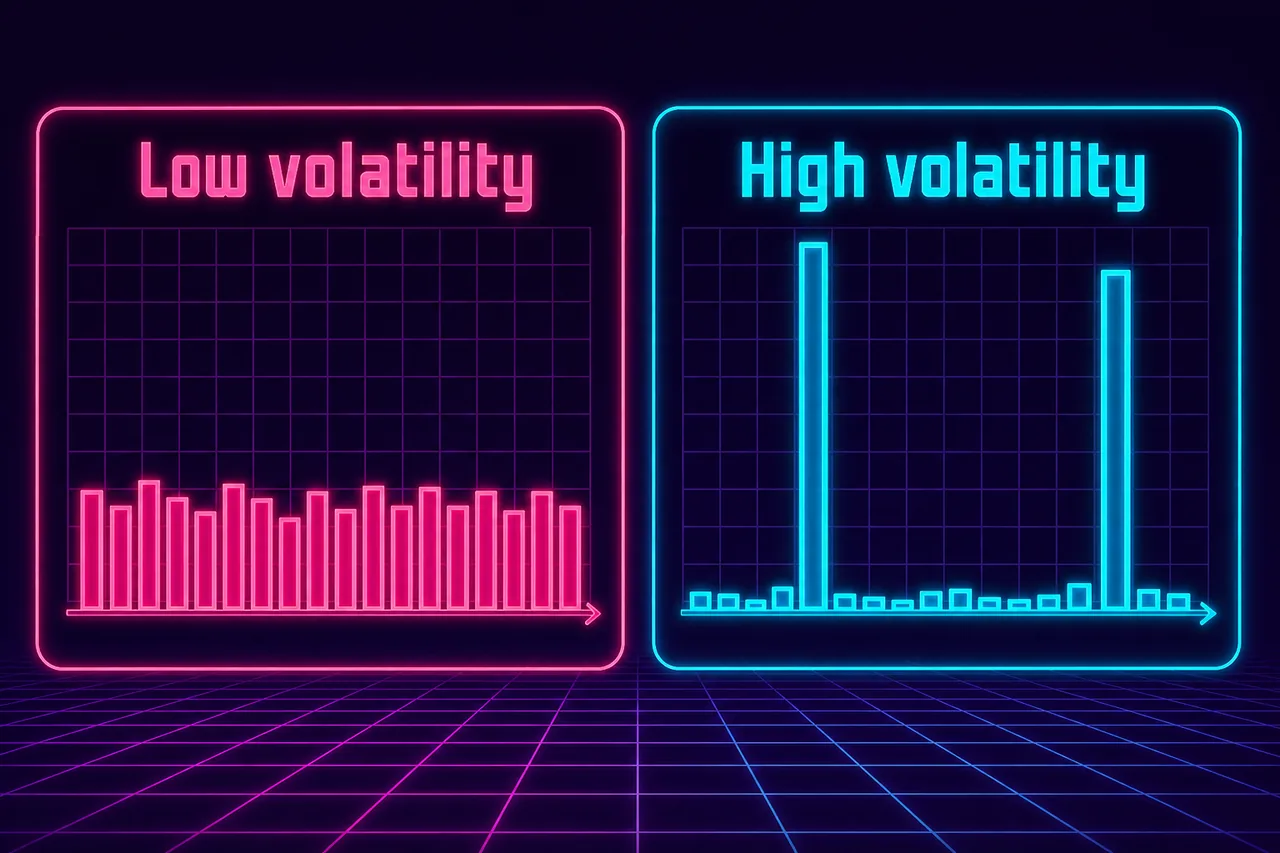
Two slots can share the same RTP and still feel nothing alike. The difference is volatility, sometimes called variance, which describes how the payouts are spread out. The UK regulator notes that only after a very large number of games does averaging even out the volatility of wins and losses.
Low Volatility in Practice
A low volatility slot pays small amounts often. Your balance drifts down slowly, with frequent little wins that keep the session going. These games suit players who want a long, calm session on a modest budget.
High Volatility in Practice
A high volatility slot pays rarely, but some of those payouts are large. Long dry spells are normal, and a session can end before any feature appears. These games suit players who accept bigger swings in exchange for the chance of a rare large hit.
The table sums up the trade-off. Both columns describe games with the same long-run return.
| Point | Low volatility | High volatility |
|---|---|---|
| How often wins land | Often | Rarely |
| Typical win size | Small | Small most of the time, very large now and then |
| Feel of a session | Steady | Long quiet stretches with sudden spikes |
| Budget needed for a long session | Smaller | Larger |
| Best for | Relaxed, longer play | Players who accept big swings |
Good to know. Volatility does not change the cost of a game over time. It changes the shape of the journey, which is why a high volatility slot can empty a small budget fast even with a decent RTP.
Features, Free Spins and Jackpots
Modern slots are more than three reels and a payline. Most add bonus features that change how and when the game pays, and those features are a big part of what makes one slot feel different from another.
- Free spin rounds hand out a set of spins, often with extra wild symbols or multipliers.
- Multipliers boost a win by a set factor during a feature.
- Pick-and-win rounds let you choose items on screen, though the prize is still set by the game’s maths.
- Progressive jackpots usually take a small slice of every stake into a growing prize pool.
Features matter because much of a slot’s RTP is often paid out inside them. A game that saves its biggest returns for a rare bonus round will feel quiet in between, which is volatility at work again.
Jackpot games deserve one extra thought. The part of each bet that feeds the jackpot is part of the game’s return, so the base game can feel tighter while the pool grows.
Find a Game’s Numbers Before You Spin
Most of what you need sits behind the small information icon inside the game. In the UK, regulated machines must make their RTP available, often in a help screen. Ontario’s regulated sites must likewise show game rules and payouts before a player starts.
- Open the game and tap the information or help icon.
- Find the RTP figure and note it down if you compare games.
- Read the paytable to see which symbols pay and how features trigger.
- Look for a volatility rating, which some studios publish.
- Check the maximum stake, since a bigger bet speeds up both wins and losses.
Getting into this habit is easier when your sources show their work. A good model is www.canada-gambling.com, which builds its pages from regulators, registers, laws and operator terms.
The site also shows a facts-last-checked date on its pages and corrects mistakes in the open, so Canadian players always know how fresh the information is.
Tip. Apply the same standard to every number you read about a slot. A figure without a source or a date is a guess, not a fact.
Slots Compared With Other Online Casino Games on Cost
Slots are rarely the cheapest game in the lobby. Published house edge tables put slots in a broad range of about 2% to 15%, depending on the game and the jurisdiction. Classic table bets often sit lower.
| Game | Typical house edge |
|---|---|
| Slots | About 2% to 15% |
| Single-zero roulette | 2.70% |
| Baccarat banker bet | 1.06% |
| Video poker, full pay Jacks or Better with best play | 0.46% |
To see what that means in dollars, picture C$3,000 in total spins over a month, as an illustrative example. At a 96% RTP, the expected cost is about C$120. The same total on single-zero roulette would cost about C$81 on average. Neither figure is a forecast for any one night.
What Slot Play Looks Like in Ontario
Ontario publishes more data than any other Canadian market, and it shows how central casino games have become. In fiscal 2024-25, online casino play brought in $2.2 billion of the province’s $2.9 billion in total gaming revenue, about three quarters of the whole.
The same report found that 71.5% of players were aware of responsible gambling tools, up from 65.4% the year before. That is encouraging, but it also means almost three in ten players were not aware of tools that already exist on their own accounts.
Good to know. Casino revenue in these reports covers slots and table games together, so it is a guide to scale rather than a slot-only figure.
Myths That Cost Slot Players Money
Most expensive slot habits come from a few stubborn beliefs. The Responsible Gambling Council addresses each of them directly.
- A slot on a long cold run is not “due” to pay. Each spin is independent.
- A near miss does not mean a win is close, even though it triggers the same reward response in the brain as a real win.
- Playing several games at once means more small wins, but also more spending and more losses overall.
- Feeling lucky has no effect on a game of chance.
- No bet is free of risk, whatever an offer or a strategy video claims.
Warning. The near-miss effect is built into how the brain responds to games. Knowing about it does not switch it off, so let your limits make the stop decision for you.
Set Up Your Slot Session in Five Minutes
A little preparation turns a slot session into a planned evening rather than an open tab. Start by choosing your budget, then pick a game whose volatility fits it.
Match the Game to the Budget
With a small budget and a wish for a long session, a low volatility game is the natural choice. With a larger budget set aside for one big swing, a high volatility game may suit you, as long as you accept that it can end quickly.
Lock In the Limits
Set a deposit limit and a session time in your account before you open the game. Canada’s lower-risk gambling guidelines also suggest avoiding regular play at more than two types of games, which keeps spending easier to track.
Tip. Pick one stake size and keep it for the whole session. Raising the stake after a loss is the quickest way to turn a normal dip into a painful night.
Know When to Walk Away
Decide in advance what ends the session: a time on the clock, a set loss or a win you are happy to keep. Write it down if that helps. A clear stopping point removes the hardest decision from the moment when you are least able to make it.
Read Your History After Every Visit
Every regulated account keeps a record of deposits, withdrawals and play. Spend a minute with it after each session. Compare what you spent with what you planned, and notice whether sessions are getting longer or more frequent.
That short review turns vague impressions into facts. It is also the simplest early warning sign there is, because a budget that keeps slipping usually shows up in the history long before it feels like a problem.
Our Verdict on Choosing Slots Wisely
Slots on regulated sites give Canadian players huge choice, tested software and published numbers that make honest comparison possible. That transparency is a real benefit, because it lets you pick games by facts rather than by flashing lights.
Warning. The limits are just as real. RTP is a long-run average, volatility decides how fast a budget moves, and the edge on slots often runs higher than on table games.
Play only if you have reached the legal age where you live; the minimum is 18 in Alberta, Manitoba and Quebec and 19 everywhere else.
If you are unsure whether your play is still healthy, the self-check quizzes from the Responsible Gambling Council take a few minutes and can be a useful first step.